
Brewing the Perfect Coffee: Your Ultimate Home Guide
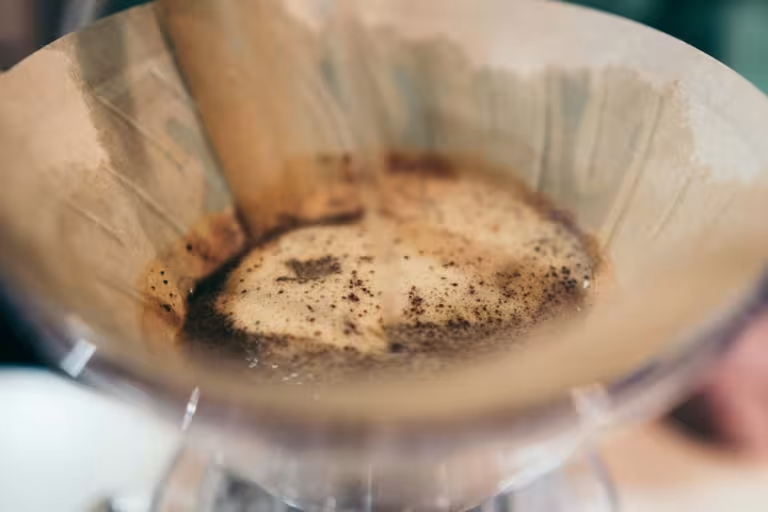
Many coffee lovers dream of making that truly exceptional cup at home, a brew that rivals their favorite cafe. The quest for the "perfect coffee" can seem complex, but with the right knowledge and a few simple adjustments, anyone can transform their morning ritual. This guide will walk you through every essential step, from selecting the finest beans to mastering brewing techniques, helping you craft a consistently delicious cup tailored to your taste.
The Foundation of Flavor: Choosing Your Beans for the Perfect Coffee
The journey to the perfect coffee begins long before the water hits the grounds. It starts with the beans themselves. Understanding what makes a good bean and how to select it is paramount. This section serves as your comprehensive coffee bean selection guide, helping you make informed choices that will significantly impact your final cup.
Arabica vs. Robusta: Understanding the Differences
The two primary species of coffee beans are Arabica and Robusta, each offering distinct characteristics:
- Arabica: This species accounts for roughly 60% of the world's coffee production. Arabica beans are known for their complex flavor profiles, often described as sweet, fruity, floral, or chocolatey, with higher acidity and a more aromatic quality. They contain less caffeine than Robusta and are generally preferred for specialty coffee due to their nuanced taste.
- Robusta: Robusta beans are hardier plants, easier to grow, and have a higher caffeine content. Their flavor is typically bolder, more bitter, and often described as rubbery or earthy, with a thicker crema when brewed as espresso. Robusta is frequently used in espresso blends for its crema and caffeine kick, and in instant coffee.
For a truly exceptional home brew, most enthusiasts gravitate towards 100% Arabica beans or blends with a high Arabica percentage, especially for methods that highlight delicate flavors.
Decoding Roast Levels
The roast level dramatically changes a bean's flavor. Coffee beans are green until roasted, and the roasting process develops their aromatic compounds and sugars. Here's a quick breakdown:
- Light Roasts: These beans are light brown, have no oil on the surface, and retain most of their original characteristics. They are often brighter, more acidic, and showcase the bean's origin flavors.
- Medium Roasts: Medium brown in color, with a slightly sweeter, more balanced flavor, and a fuller body than light roasts. They offer a good balance between the bean's original flavor and the flavors developed during roasting.
- Medium-Dark Roasts: These beans are darker brown with some oil on the surface. They have a richer, bolder flavor, with less acidity and a slightly bittersweet aftertaste.
- Dark Roasts: Dark brown, almost black, with an oily surface. Dark roasts have a pronounced bitterness, smoky or charred notes, and very little of the bean's original character remains. The body is often heavier.
Experiment with different roast levels to discover what you prefer. A medium roast is often a good starting point for many brewing methods, offering versatility and a balanced flavor.
The Importance of Freshness and Proper Storage
Coffee is an agricultural product, and like any fresh produce, its flavor degrades over time. Freshness is non-negotiable for the perfect coffee. Look for beans with a 'roasted on' date, not just an 'expiration date'. Aim to buy beans roasted within the last 1-2 weeks and consume them within 3-4 weeks of roasting.
Once opened, proper storage is vital to preserve flavor:
- Airtight Container: Store beans in an opaque, airtight container. Exposure to air, light, moisture, and heat are coffee's enemies.
- Cool, Dark Place: Keep the container in a pantry or cupboard, away from direct sunlight and heat sources.
- Avoid the Fridge/Freezer (mostly): While some debate exists, generally avoid storing coffee in the refrigerator as it can absorb odors and moisture. Freezing can be an option for long-term storage of unopened bags, but once opened, frequent temperature changes can cause condensation and degrade quality.
Bean Origin and Ethical Sourcing
The origin of your coffee beans tells a story about its flavor profile. Beans from different regions (e.g., Ethiopia, Colombia, Brazil, Indonesia) have distinct characteristics due to soil, climate, and processing methods. For instance, Ethiopian coffees are often bright and floral, while Indonesian coffees can be earthy and full-bodied.
Beyond taste, consider ethical sourcing. Look for certifications like Fair Trade, Rainforest Alliance, or direct trade relationships, which indicate that farmers are paid fairly and sustainable practices are followed. Supporting ethically sourced coffee not only tastes good but also does good.
The Art of the Grind: Precision for the Perfect Coffee
Once you've chosen your beans, the next critical step in brewing the perfect coffee is grinding. The grind size and consistency are often overlooked but have a profound impact on extraction and, consequently, taste.
Why Grind Matters
Coffee extraction is the process of dissolving desirable flavors from the ground coffee into the hot water. The surface area of the coffee grounds dictates how quickly and effectively this extraction occurs. A finer grind means more surface area, leading to faster extraction. A coarser grind means less surface area and slower extraction.
- Too Fine: Leads to over-extraction, resulting in a bitter, astringent, or harsh taste.
- Too Coarse: Leads to under-extraction, resulting in a weak, sour, or watery taste.
The goal is to achieve an even extraction, where all the desirable compounds are dissolved without the undesirable ones. This requires the correct grind size for your chosen brewing method and a consistent grind.
Grind Size for Different Methods
Different brewing methods require specific grind sizes to achieve optimal extraction:
- Extra Coarse: Resembles peppercorns. Ideal for Cold Brew.
- Coarse: Similar to sea salt. Perfect for French Press and Percolators.
- Medium-Coarse: Like rough sand. Works well for Chemex and Clever Dripper.
- Medium: Similar to regular sand. Suitable for Drip Coffee Makers and Aeropress (longer brew times).
- Medium-Fine: Finer than sand, slightly coarser than espresso. Good for Pour Over (e.g., V60) and Aeropress (shorter brew times).
- Fine: Resembles table salt. Essential for Espresso machines.
- Extra Fine/Turkish: Powder-like. Used for Turkish coffee.
Always adjust your grind based on your specific brewer and personal taste. If your coffee tastes bitter, try a coarser grind. If it tastes sour or weak, try a finer grind.
Types of Grinders: Blade vs. Burr
The type of grinder you use is as important as the grind size itself.
- Blade Grinders: These grinders operate like blenders, chopping coffee beans with spinning blades. They produce an inconsistent grind with varying particle sizes, leading to uneven extraction and a less flavorful cup. While affordable, they are generally not recommended for brewing the perfect coffee.
- Burr Grinders: Burr grinders crush coffee beans between two abrasive surfaces (burrs). This method produces a much more consistent and uniform grind, which is crucial for even extraction. Burr grinders come in two main types:
- Wheel Burr Grinders: Less expensive, but can be louder and generate more heat.
- Conical Burr Grinders: Generally preferred for their quiet operation, lower heat generation, and superior grind consistency.
Investing in a good quality burr grinder is one of the most significant upgrades you can make to your home coffee setup. It allows you to precisely control your grind, which is fundamental to making coffee taste better.
Water: The Unsung Hero of Your Brew
Often overlooked, water constitutes over 98% of your coffee. Its quality and temperature play a surprisingly significant role in the final taste of your perfect coffee. You wouldn't use dirty water for cooking, and the same principle applies to coffee.
The Importance of Water Quality
Tap water, depending on your location, can contain chlorine, minerals, or other impurities that can negatively affect your coffee's flavor. Chlorine can react with coffee compounds, creating off-flavors, while excessive mineral content can hinder proper extraction.
For the best results, use filtered water. This doesn't necessarily mean expensive bottled water; a simple Brita filter or a filter attached to your tap can make a noticeable difference. The ideal water for coffee is clean, fresh, odorless, and has a balanced mineral content (not too soft, not too hard). Water that is too soft can lead to under-extracted, weak coffee, while water that is too hard can lead to over-extracted, bitter coffee.
Optimal Water Temperature
The temperature of your brewing water is another critical factor. Water that is too cold will under-extract the coffee, resulting in a sour, weak, and underdeveloped flavor. Water that is too hot can burn the coffee grounds, leading to over-extraction and a bitter, harsh taste.
The generally accepted ideal brewing temperature range is between 195°F and 205°F (90°C and 96°C). This range allows for optimal extraction of the coffee's desirable flavors without burning the grounds. If you don't have a temperature-controlled kettle, a good rule of thumb is to bring water to a boil and then let it sit for about 30-60 seconds off the heat before pouring. This allows the temperature to drop into the ideal range.
Using a kettle with a built-in thermometer or a separate thermometer can help you hit this sweet spot consistently, ensuring your water is always ready to contribute to the perfect coffee.
Mastering the Brew: Exploring Best Coffee Brewing Methods
With your perfectly selected, freshly ground beans and ideal water, it's time to explore the various best coffee brewing methods. Each method offers a unique experience and highlights different aspects of the coffee's flavor profile. Experimentation is key to finding your favorite way to make coffee taste better.
Pour Over (e.g., Hario V60, Chemex)
Pour over brewing is celebrated for its clean, bright, and nuanced cups. It allows for precise control over the brewing process, making it a favorite among specialty coffee enthusiasts.
- How it works: Hot water is slowly poured over a bed of coffee grounds in a filter, allowing gravity to draw the brewed coffee into a carafe below.
- Ideal Grind: Medium-fine to medium-coarse, depending on the specific brewer and flow rate.
- Key to Success: A gooseneck kettle for controlled pouring, a scale for precise ratios, and a consistent pour technique (often involving a 'bloom' phase).
- Flavor Profile: Clean, aromatic, highlights origin characteristics, light to medium body.
French Press
The French Press is known for producing a full-bodied, rich cup of coffee with a robust flavor. It's a simple immersion method that leaves coffee oils and fine sediment in the cup, contributing to its characteristic mouthfeel.
- How it works: Coarsely ground coffee is steeped in hot water for several minutes, then a plunger with a mesh filter is pressed down to separate the grounds from the liquid.
- Ideal Grind: Coarse.
- Key to Success: Proper steep time (typically 4 minutes), correct water temperature, and a gentle, even press.
- Flavor Profile: Full-bodied, rich, bold, often with a pleasant sediment.
Espresso
Espresso is a concentrated coffee shot, forming the base for many popular milk-based drinks like lattes and cappuccinos. It requires specialized equipment but offers an intense, aromatic experience.
- How it works: Hot, pressurized water is forced through a finely packed bed of finely ground coffee.
- Ideal Grind: Very fine.
- Key to Success: High-quality espresso machine, consistent fine grind, precise dosing, and proper tamping.
- Flavor Profile: Intense, concentrated, rich, with a characteristic crema layer.
Aeropress
The Aeropress is a versatile and portable brewer known for its speed and ability to produce a clean, full-flavored cup. It's excellent for travel and experimentation.
- How it works: Coffee grounds are steeped in hot water, then pressed through a paper filter using a plunger, creating pressure that extracts the coffee.
- Ideal Grind: Medium to medium-fine, depending on the recipe.
- Key to Success: Experimentation with grind size, water temperature, and steep/press time.
- Flavor Profile: Clean, smooth, full-bodied, with low acidity.
Drip Coffee Machine
The automatic drip coffee maker is a staple in many homes for its convenience and ease of use. While often seen as basic, a good quality machine can produce a very satisfying cup.
- How it works: Water is heated and dripped over coffee grounds in a filter basket, then flows into a carafe.
- Ideal Grind: Medium.
- Key to Success: Use a machine with a good showerhead for even water distribution and a heating element that reaches the correct temperature. Clean your machine regularly.
- Flavor Profile: Balanced, consistent, easy to brew in larger quantities.
Cold Brew
Cold brew offers a smooth, low-acid coffee concentrate that's perfect for iced coffee or mixing with milk. It's an immersion method that uses cold water and a long steep time.
- How it works: Coarsely ground coffee is steeped in cold water for 12-24 hours, then filtered.
- Ideal Grind: Extra coarse.
- Key to Success: Long steep time, proper coffee-to-water ratio, and good filtration.
- Flavor Profile: Smooth, low acidity, naturally sweet, concentrated.
Each of these methods has its own charm. Don't be afraid to try a few to discover which one consistently delivers your perfect coffee.
Fine-Tuning Your Cup: How to Make Coffee Taste Better
Even with the best beans, grinder, water, and brewing method, there's always room for adjustment. This section focuses on practical tips and troubleshooting to help you consistently make coffee taste better, tailoring it precisely to your preferences.
The Golden Ratio: Coffee-to-Water
One of the most fundamental adjustments you can make is the coffee-to-water ratio. This ratio dictates the strength of your brew. A common starting point, often called the 'golden ratio,' is 1:15 to 1:18 (coffee to water by weight). This means for every 1 gram of coffee, you use 15 to 18 grams of water.
- If your coffee is too weak: Use more coffee or less water (e.g., a 1:14 ratio).
- If your coffee is too strong: Use less coffee or more water (e.g., a 1:18 ratio).
Using a kitchen scale to measure both your coffee grounds and water by weight is far more accurate than using scoops and volume measurements, leading to much greater consistency.
Brew Time: A Delicate Balance
Brew time is directly related to extraction. The longer the water is in contact with the coffee grounds, the more compounds are extracted. However, there's a point of diminishing returns where undesirable bitter compounds begin to dissolve.
- If your coffee tastes sour or underdeveloped (under-extracted): Increase your brew time (or make your grind finer).
- If your coffee tastes bitter or astringent (over-extracted): Decrease your brew time (or make your grind coarser).
Keep a timer handy for all your brewing methods. Even small changes in brew time can significantly alter the flavor.
Troubleshooting Common Issues
Here's a quick guide to diagnosing and fixing common coffee problems:
- Too Bitter/Harsh: This usually indicates over-extraction. Try a coarser grind, shorter brew time, or slightly cooler water.
- Too Sour/Weak/Watery: This often points to under-extraction. Try a finer grind, longer brew time, hotter water, or a higher coffee-to-water ratio.
- Flat/Dull: Your beans might not be fresh, or your water quality could be an issue. Ensure you're using freshly roasted beans and filtered water.
- Muddy/Sludgy: Your grind might be too fine for your brewing method, or your filter isn't effective enough.
Thoughtful Additions: Milk, Sugar, and Spices
While purists might prefer black coffee, there's no shame in enjoying your brew with additions. The key is to use them thoughtfully to complement, not mask, the coffee's flavor.
- Milk/Cream: Choose high-quality dairy or non-dairy alternatives. Steaming milk properly (for lattes/cappuccinos) can add natural sweetness and a silky texture.
- Sugar/Sweeteners: Start with a small amount and taste. Consider alternatives like honey, maple syrup, or agave for different flavor notes.
- Spices: A pinch of cinnamon, nutmeg, or cardamom can add warmth and complexity. Add them to the grounds before brewing or sprinkle on top of your finished cup.
Remember, the perfect coffee is ultimately the one you enjoy the most. Don't be afraid to experiment and adjust until you find your ideal cup.
Beyond the Basics: Advanced Tips for the Perfect Coffee
Once you've mastered the fundamentals, a few advanced practices can elevate your home brewing even further, ensuring consistency and helping you truly perfect your coffee ritual.
Embrace Precision Tools: Scales and Timers
As mentioned, precision is key. While you can start with approximations, using a digital kitchen scale and a timer will transform your brewing consistency. A scale allows you to measure coffee grounds and water by weight, eliminating guesswork. A timer ensures you hit your target brew times accurately, preventing under or over-extraction.
- Coffee Scale: Look for one that measures in 0.1-gram increments and has a built-in timer.
- Timer: Even your phone's timer works, but a dedicated timer on your scale or a separate one is convenient.
These tools remove variables, allowing you to replicate successful brews and troubleshoot less successful ones with greater accuracy.
Keep a Brewing Journal
To truly understand what works best for your palate and specific beans, consider keeping a simple brewing journal. Note down:
- Bean Details: Origin, roast level, roast date.
- Grind Setting: Your grinder's specific setting.
- Coffee Weight: In grams.
- Water Weight/Volume: In grams or milliliters.
- Water Temperature: If you measure it.
- Brew Time: Total contact time.
- Taste Notes: What you liked, what you didn't, what you'd change next time.
This practice helps you identify patterns, refine your technique, and consistently reproduce your favorite results. It's an excellent way to learn how to make coffee taste better over time.
Regular Cleaning and Maintenance of Equipment
Even the best equipment will produce subpar coffee if it's not clean. Coffee oils can build up, become rancid, and impart off-flavors to your brew. Regular cleaning is essential for maintaining the quality of your coffee.
- Daily: Rinse all parts that come into contact with coffee (filter baskets, carafes, plungers) with hot water immediately after use.
- Weekly: Deep clean your grinder to remove old coffee grounds and oils. Use a brush or specialized grinder cleaner.
- Monthly/Bi-Monthly: Descale your coffee maker or espresso machine to remove mineral buildup. Follow the manufacturer's instructions, often using vinegar or a descaling solution.
A clean machine ensures that every cup tastes fresh and pure, allowing the true flavors of your carefully selected beans to shine through.
Frequently Asked Questions
Q: How long do coffee beans stay fresh after opening?
A: Ideally, whole coffee beans should be consumed within 2-3 weeks after opening for optimal flavor. Ground coffee loses freshness much faster, often within minutes, which is why grinding just before brewing is highly recommended.
Q: Can I use pre-ground coffee for the perfect coffee?
A: While convenient, pre-ground coffee rapidly loses its aromatic compounds and flavor. For the perfect coffee, it's strongly recommended to buy whole beans and grind them immediately before brewing. This single step makes a significant difference in taste.
Q: What's the best way to store coffee?
A: Store whole coffee beans in an opaque, airtight container in a cool, dark place, away from heat and light. Avoid the refrigerator, as it can introduce moisture and odors. Freezing can be an option for unopened bags for longer storage, but once opened, it's best to keep them in the pantry.
Q: My coffee tastes bitter. What should I do?
A: Bitterness often indicates over-extraction. Try making your grind coarser, reducing your brew time, or slightly lowering your water temperature. Also, ensure your equipment is clean, as old coffee oils can cause bitterness.
Q: My coffee tastes sour or weak. How can I fix it?
A: Sourness or weakness usually points to under-extraction. Try making your grind finer, increasing your brew time, using hotter water (within the 195-205°F range), or increasing your coffee-to-water ratio.
Further Reading Suggestions
- The World Atlas of Coffee by James Hoffmann: A comprehensive guide to coffee, from bean to cup.
- Coffee Obsession by DK Publishing: A visually rich book covering coffee history, varieties, and brewing.
- Barista Hustle Blog: An excellent online resource for in-depth articles on coffee science and brewing techniques.
- Specialty Coffee Association (SCA) Resources: Offers educational materials and standards for quality coffee.
Conclusion
Brewing the perfect coffee at home is a rewarding journey, not a destination. It's about understanding the variables, experimenting with different techniques, and ultimately, discovering what truly delights your palate. From carefully selecting your beans using a detailed coffee bean selection guide, to mastering the grind, controlling water quality, and exploring the best coffee brewing methods, every step contributes to the final cup.
Remember that the quest to make coffee taste better is an ongoing process of learning and adjustment. Don't be intimidated by the details; instead, embrace the opportunity to refine your skills and personalize your brew. With the insights and practical advice from this guide, you have everything you need to transform your daily coffee ritual into an exceptional experience. So, go forth, experiment, and enjoy the rich, aromatic world of home-brewed coffee!